Technology deep-dive

Salinity-gradient (osmotic) energy

When river freshwater meets the sea, the mixing releases Gibbs free energy — about 0.8 kWh of theoretically extractable energy per cubic metre of river water meeting seawater. Two families of membrane technology — pressure-retarded osmosis (PRO) and reverse electrodialysis (RED) — exist to capture some of that flux. India’s many large river-sea interfaces give it a structurally large theoretical resource, captured technically as “blue energy” in its narrow, original academic sense.

PRO RED River-sea interface Andhra Pradesh West Bengal Pilot stage
How to read every ocean energy number on this site. Every statistic — 9.2 lakh TWh headline, “GWh per estuary”, pilot-plant capacities — is presented at four levels: resource potential (the Gibbs energy released by mixing at the river-sea interface), extractable potential (what real membranes and electrodes can recover), techno-economic potential (what is plausibly deployable at plausible cost with the right membrane economics) and project feasibility (what survives membrane lifetime, fouling, permitting and offtake). The largest number is always the resource potential and is almost never what gets built. For any deployment-relevant figure, look at the techno-economic line. In salinity-gradient energy specifically, the gap is especially wide because the technology is at early pilot stage.

The thermodynamic resource

When two salt solutions of different concentrations mix, they release Gibbs free energy — the energy available to do useful work at constant temperature and pressure. The textbook estimate is that when fresh river water (effectively 0 g/kg salinity) mixes with seawater (~35 g/kg), the theoretical extractable energy is around 0.8 kWh per cubic metre of fresh water processed, or equivalently across the mixing of about 1.6 kg of freshwater with 4.4 kg of seawater.

Two technologies exist to capture some of this energy without the full mixing-driven dilution loss:

  • Pressure-retarded osmosis (PRO) — a semi-permeable membrane between the freshwater and seawater sides lets water diffuse from the dilute side to the concentrated side, pressurising the seawater outflow enough to drive a turbine. The product is mechanical (and hence electrical) power.
  • Reverse electrodialysis (RED) — a stack of alternating anion- and cation-exchange membranes, with electrode pairs at the ends; the chemical-potential difference drives ionic migration, generating a stack voltage that decays as current is drawn.

Both technologies are at lab and small-pilot scale. PRO has the larger global installed pilot capacity; RED has been gaining academic interest because it avoids high-pressure components.

Educational diagram of PRO salinity-gradient energy: fresh river water on one side, seawater on the other, separated by a semi-permeable membrane, with pressurised seawater driving a turbine.
PRO — the membrane allows water to diffuse selectively, pressurising the seawater side enough to drive a turbine at modest pressure ratios.
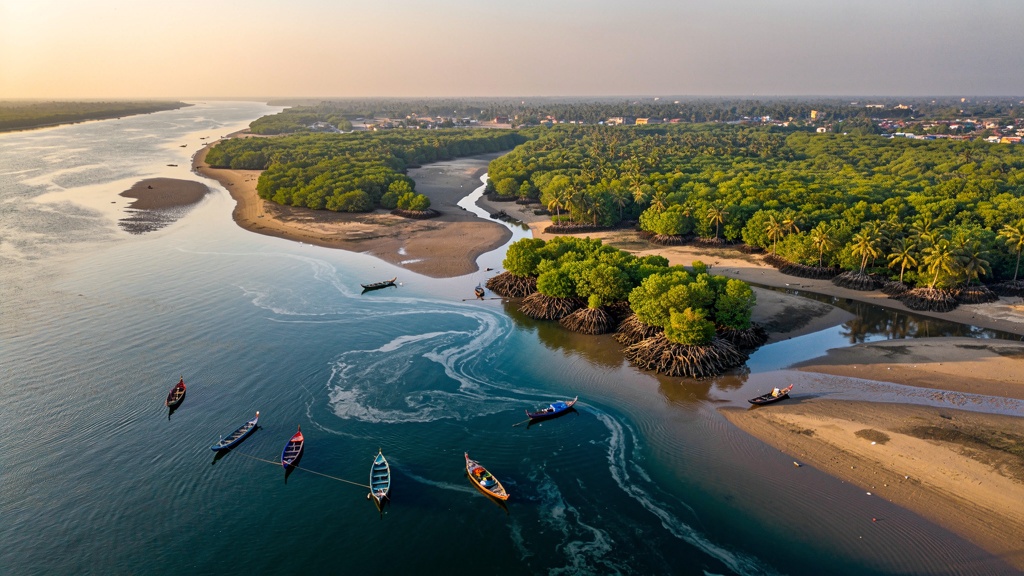
Aerial photograph of a wide tropical estuary in Andhra Pradesh where river freshwater meets blue seawater, with mangrove strips and small fishing boats.
An Indian river-sea interface — the structural resource for salinity-gradient energy.
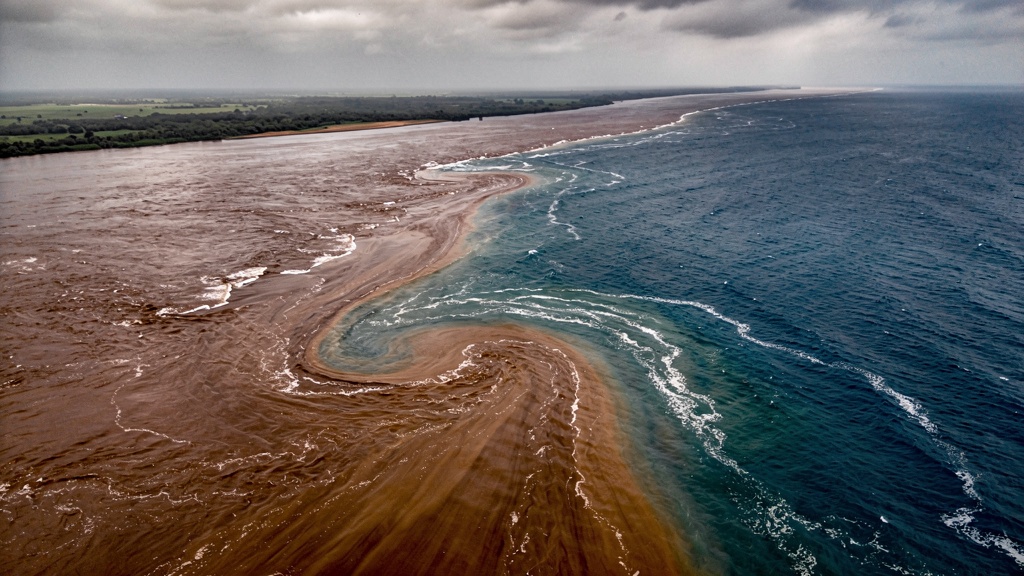
Moody photograph where a large river’s brown freshwater meets blue seawater along the Indian coast, with strong colour contrast.
A natural salinity gradient is a continuous interface, not a step change.
Educational diagram of PRO salinity-gradient energy with a turbine in a closed loop.
PRO — pressurised permeate drives a turbine before being depressurised.
Where in India

Indian river-sea interfaces with the right geometry

The salinity-gradient resource in India is structurally large because India has many large, perennial rivers flowing into the sea. But the engineering value of an estuary depends on geometry: how concentrated the freshwater plume is at the point the membrane bank sits, how stable the salinity profile is, and how much freshwater is genuinely available to be processed.

🌊

Andhra Pradesh — Krishna, Godavari, Penna

Three large perennial rivers, strong seasonal concentration of discharge, estuaries that retain a sharp salt-fresh interface for several kilometres inland. Identified by several Indian academic groups as the country’s strongest salinity-gradient resource.

🛶

West Bengal — Hooghly

The Hooghly estuary carries the Ganga’s flow past Kolkata to the Bay of Bengal; flow is partly regulated by the Farakka barrage, which complicates continuous operation. Strong academic interest; pilot proposals are rare.

🏖️

Odisha — Mahanadi, Brahmani, Baitarani

Multiple estuaries with seasonal concentration; freshwater plume stable during south-west monsoon post-peak; some academic resource mapping.

🌴

Kerala, Karnataka, Goa

Shorter west-coast rivers but sharp salinity gradients; many small estuaries and backwater confluences; small-scale distributed pilots are plausible.

🛢️

Gujarat — Narmada, Tapi, Sabarmati

Rivers with strong seasonal flow; tidal reach extends salinity intrusion upstream, which expands the interface zone.

🧭

Tamil Nadu — Cauvery, Palar, Ponnaiyar

Smaller estuaries with dam-regulated flows; a separate question is whether the engineered salinity stratification is sufficiently stable for plant operation.

The water-throughput question

The single counterintuitive constraint

The single biggest practical constraint facing salinity-gradient plants is also the easiest to miss: how much river water flows into the estuary in a typical year, and how much of that water can reasonably be processed by a plant before you start to divert water from other uses like fisheries, irrigation, navigation and community supply.

A 1 MW PRO plant operating with realistic flux densities would require roughly 5–10 m³/s of salinity-graded flow through the membrane bank. A 100 MW plant requires 50–100 times that — and these distributions sit inside an estuary where the freshwater stream is already allocated for irrigation, drinking water and ecological flows. You don’t divert a river to make electricity.

The standard answer in the literature is therefore that salinity-gradient plants are extremely distributed — many small modules at many sites — rather than single large facilities. Distributed 100 kW-class installations can be sited without disturbing flow allocations.

Distributed is the realistic framing. The salinity-gradient energy opportunity in India does not look like a single mega-project at the Ganga’s mouth. It looks like hundreds-to-thousands of small membrane banks at smaller estuaries — each displacing tens to hundreds of kW at the local load centre.
Status snapshot

Reality check: PRO and RED today

Salinity-gradient energy — what is measured, what is built, what is gated
AspectStatus as of 2024–2025
Resource potentialMulti-GWh/yr aggregate at India’s main estuaries. Concentrated in Andhra Pradesh and Bengal.
Techno-economic potentialA small fraction of resource once realistic freshwater allocation and membrane economics are honoured.
Deployed capacity in IndiaNo operating installations. Lab-scale work at a handful of Indian institutions (IIT Kharagpur, IIT Madras, IISc Bengaluru, NIT Tiruchirappalli reports since the 2010s).
Global installed referenceStatkraft’s prototype PRO plant at Tofte, Norway (since 2009, ~10 kW scale) is the most-cited global reference, operated at pilot scale.
Membrane lifetimeA practical bottleneck. PRO membranes lose performance to fouling, compaction and chemical cleaning cycles over 12–24 months of continuous operation.
Strongest frictionMembrane cost and lifetime; freshwater allocation; intermittent salinity profile managed by tidal mixing; permitting of in-water membrane banks.

Working principle in one paragraph

A PRO plant puts a semi-permeable membrane between two streams — a freshwater stream and a seawater stream. Natural osmotic flow draws water from the freshwater side into the seawater side, building pressure in the seawater side that is partially recovered through a turbine before depressurisation. The two streams then continue downstream. The energy captured is a function of membrane area, flux density, pressure ratio and turbine efficiency. RED’s working principle is similar but uses an alternating stack of ion-exchange membranes with electrodes at each end — chemical-potential difference drives ionic migration which is converted to direct current at modest voltages.

Caps on extraction efficiency

The textbook 0.8 kWh per m³ of water processed is the thermodynamic ceiling. Real PRO and RED plants extract a small fraction of this because:

  • Membrane permeability is finite, so the pressure build-up in the seawater side is limited to typically 10–15 bar before reversal begins.
  • Concentration polarisation on the membrane interface degrades performance.
  • Fouling and compaction over time raise hydraulic resistance.
  • The turbine cycle cannot recover all the osmotic pressure work.

Realistic net extractable figures in published pilot data are commonly 10–30% of the thermodynamic ceiling. State it carefully when quoting capacity numbers.

Why the technology matters even at small scale

Salinity-gradient plants are not usually the headline answer to India’s energy mix, but they are attractive at the right scale because:

  • They are continuous (24/7) — unlike solar PV and unlike wave in calm seas.
  • They are predictable — salinity profiles are relatively stable from week to week compared with wind variability.
  • They pair naturally with local grid or community micro-grid applications near the estuary.
  • They can supply dispatchable baseload power to a small island or community in a hybrid platform (see hybrid systems).

Environmental considerations

Salinity-gradient plants have a low-impact thermal and chemical profile compared with most thermal power, but raise their own questions:

  • Brine discharge — concentrated brine leaves the plant; its disposal must not impact local ecology.
  • Membrane chemicals — cleaning reagents typically include surfactants and pH-adjusting chemicals; pretreatment may be needed.
  • Freshwater extraction — taking freshwater out of an estuary during dry-season low flow could affect downstream fisheries and irrigation.
  • Marine spatial planning — placement of in-river or coastal membrane banks sits inside CRZ, fisheries and water-allocation frameworks.

Honest outlook

Salinity-gradient power remains the least mature, least talked-about form of Indian blue energy. That is consistent with the global picture — Statkraft’s Tofte pilot is the most-cited reference worldwide and even that has not prompted a commercial-trajectory leap. Read the literature honestly and you will conclude:

  1. In the next 5 years, expect lab and small pilot deployments in India — likely in academic partnership with regional state authorities.
  2. In the 10–15 year horizon, distributed sub-MW installations at carefully chosen estuary sites are plausible.
  3. Multi-MW commercial salinity-gradient plants are not on the horizon for India under realistic technology and membrane lifetime assumptions.
  4. The big lever is improved membrane lifetime, which is being chased by the global membrane-research community and is not India-specific.

For a research-flavoured reality check, see projects & technology for current Indian pilots, and hybrid systems for how salinity-gradient may sit inside modular distributed hybrid devices.

FAQ

Salinity-gradient energy questions

Is this the same as the global sense of “blue energy”?
In some early academic literature, yes. In India’s recent official usage, the term covers a broader family (wave, tidal, OTEC, currents, salinity, offshore wind, floating solar). On this site, the broader definition is the primary one — and salinity-gradient energy is a meaningful, narrow contributory form within it.
Is salinity-gradient realistic in India before 2030?
At distributed sub-MW scale, yes — particularly with strong academic and state-government partnership. At commercial scale above a few MW, not on the global trajectory at present.
Is it environmentally safe to put membranes in an estuary?
The footprint per unit energy is small compared with most thermal or large hydropower alternatives. But freshwater extraction is non-zero — siting needs to be done within the prevailing water allocation, irrigation and ecological-flows framework for that estuary.
What about combining PRO with desalination?
A natural pairing. A PRO plant draws freshwater from the dilute side anyway, so you can route some of that freshwater as potable water after light post-treatment — particularly relevant for estuary communities.